Learning how to get into voice over work now means picking one niche, treating a small recording space, training the read with a coach, and auditioning where humans still cast — then protecting your voice in the contract.
Quick steps
Voice-over hiring still happens every week, but the entry points are narrower than they were five years ago. Treat your first three months as a sequence rather than a scramble.
- Pick one niche — e-learning, explainer video, audiobook or local commercial — and record only that for your first month.
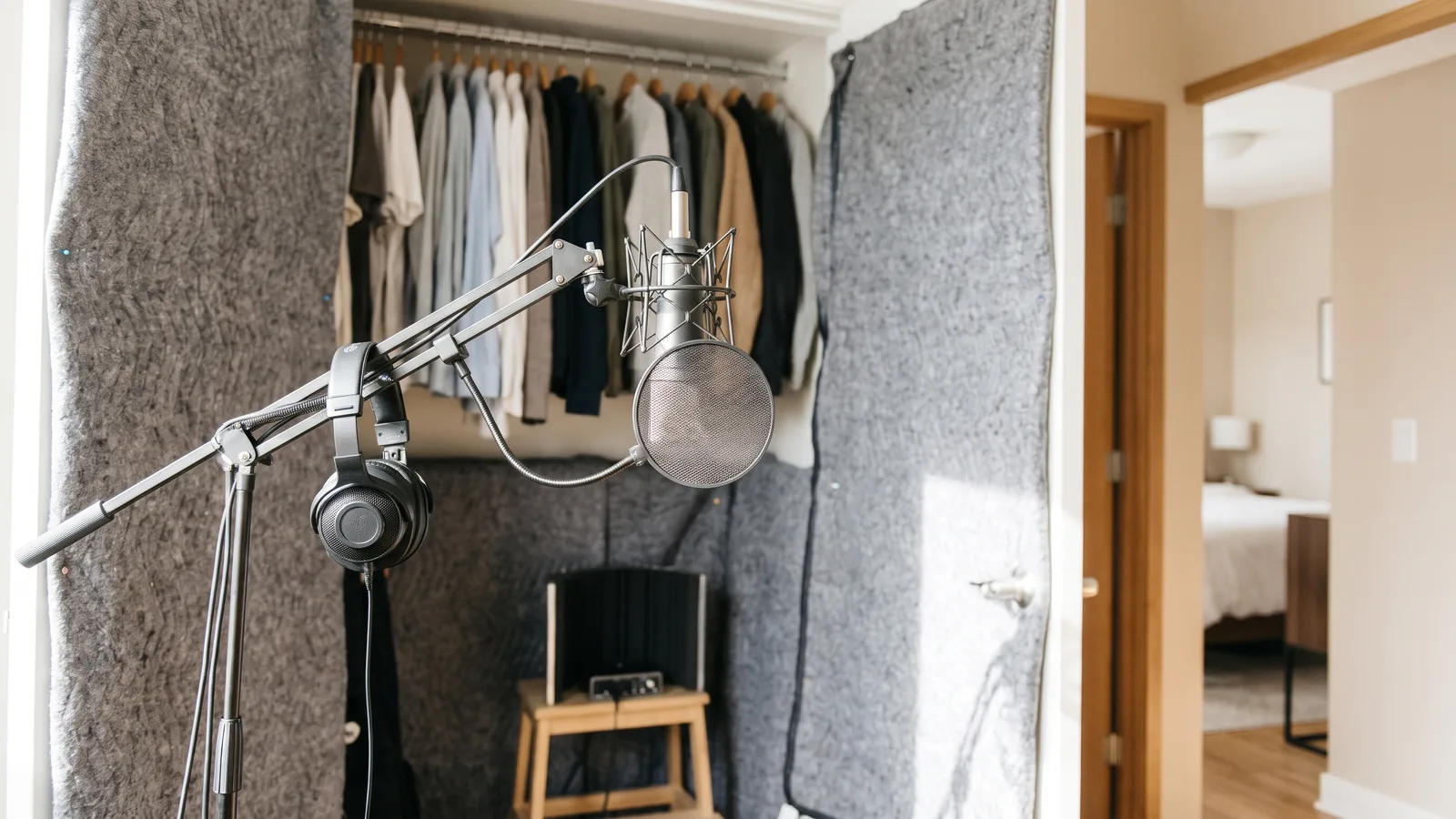
- Build a treated recording space inside a closet or against a wall of soft mass, then test your noise floor before buying a second microphone.
- Cut a demo of roughly 60 to 90 seconds, strongest read first, because buyers rarely listen past the opening lines.
- Book two or three coaching sessions with a working voice actor or casting director who will critique that demo before you publish it.
- Audition where humans still read submissions: one paid platform, five agency submissions, and a weekly batch of direct emails to local production companies.
Each section below fills in the detail — the gear thresholds that actually matter, the rate questions to ask before quoting, and the contract clause that keeps your voice from being cloned without payment.
Voice-over work in the AI era: what’s actually still being booked
Synthetic voices took the bottom of the market first. Phone trees, internal compliance modules, throwaway product blurbs and placeholder scratch tracks are now routinely generated rather than cast. Those were the jobs beginners used to cut their teeth on, which is why the ladder feels missing.
What still gets cast with human performers: character and animation work, long-form narration that has to hold attention for hours, national brand campaigns, pharmaceutical and medical copy with legal exposure, trailer reads, live event hosting, and children’s content where parents and broadcasters scrutinize delivery.
The U.S. Bureau of Labor Statistics projects 0% change — little or no growth — in actor employment over the 2024–34 decade, so newcomers are competing for a fixed pool of roles. In the independent State of Voice Acting survey of working voice actors published by Voice Crafters, 73.9% said they had definitely or probably lost work to AI, and 39.8% said definitely.
Read those two numbers as a routing instruction, not a verdict. The work that remains rewards performance choices, direction-taking and accountability — three things a text-to-speech render cannot be held to. If you want to understand what buyers are comparing you against, this breakdown of how accurate AI voice detectors actually are in benchmark testing is a useful reality check.
Step 1 — Choose a beginner-friendly niche AI hasn’t commoditized
Time needed: one week of research. What you need: a list of ten real buyers in your chosen niche, with names and email addresses.
Generalists lose to specialists at the beginner stage because a casting director cannot picture where you fit. Pick one lane, build everything around it for 90 days, and widen later.
Strong starting lanes, with their trade-offs:
| Niche | Why it’s open to beginners | The catch |
|---|---|---|
| E-learning and corporate training | Steady volume, forgiving reads, repeat clients | Rates compress fastest here as synthetic voices improve |
| Audiobook narration | Hungry for new narrators, royalty-share entry points exist | Punishing hours per finished hour; you also engineer and proof |
| Local and regional commercial | Real budgets, humans cast it, relationships stick | Requires direct outreach to stations and agencies, not platforms |
| Explainer and YouTube narration | Creators hire fast and pay fast | Many creators test synthetic voices first; you win on direction |
| Character, games and animation | Least exposed to commoditization | Longest runway before your first booking |
Backstage reports that new audiobook narrators typically need about 10 hours of work to deliver one finished hour of audio, versus about six hours for experienced narrators. Run that math against any per-finished-hour offer before you accept it.
One honest filter: listen to the synthetic competition in your niche. Where machine reads still fall apart — emotional pivots, long-form consistency, dialogue — is where your auditions get read, and this guide to why AI dubbing often sounds wrong and what causes it maps those failure points.
Step 2 — Build a usable home booth and a demo that survives the first 30 seconds
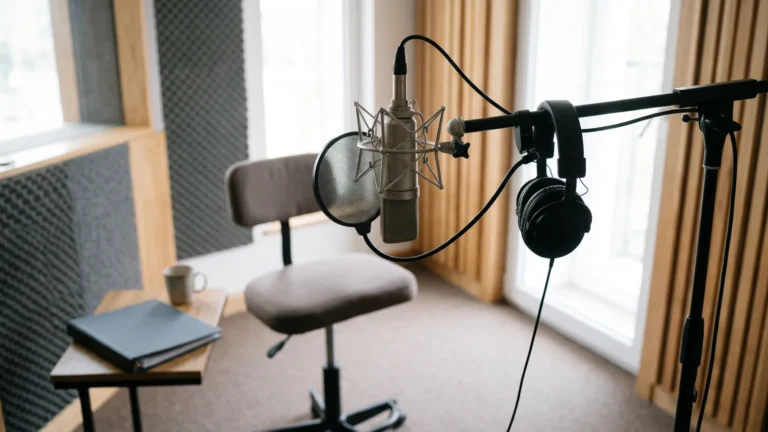
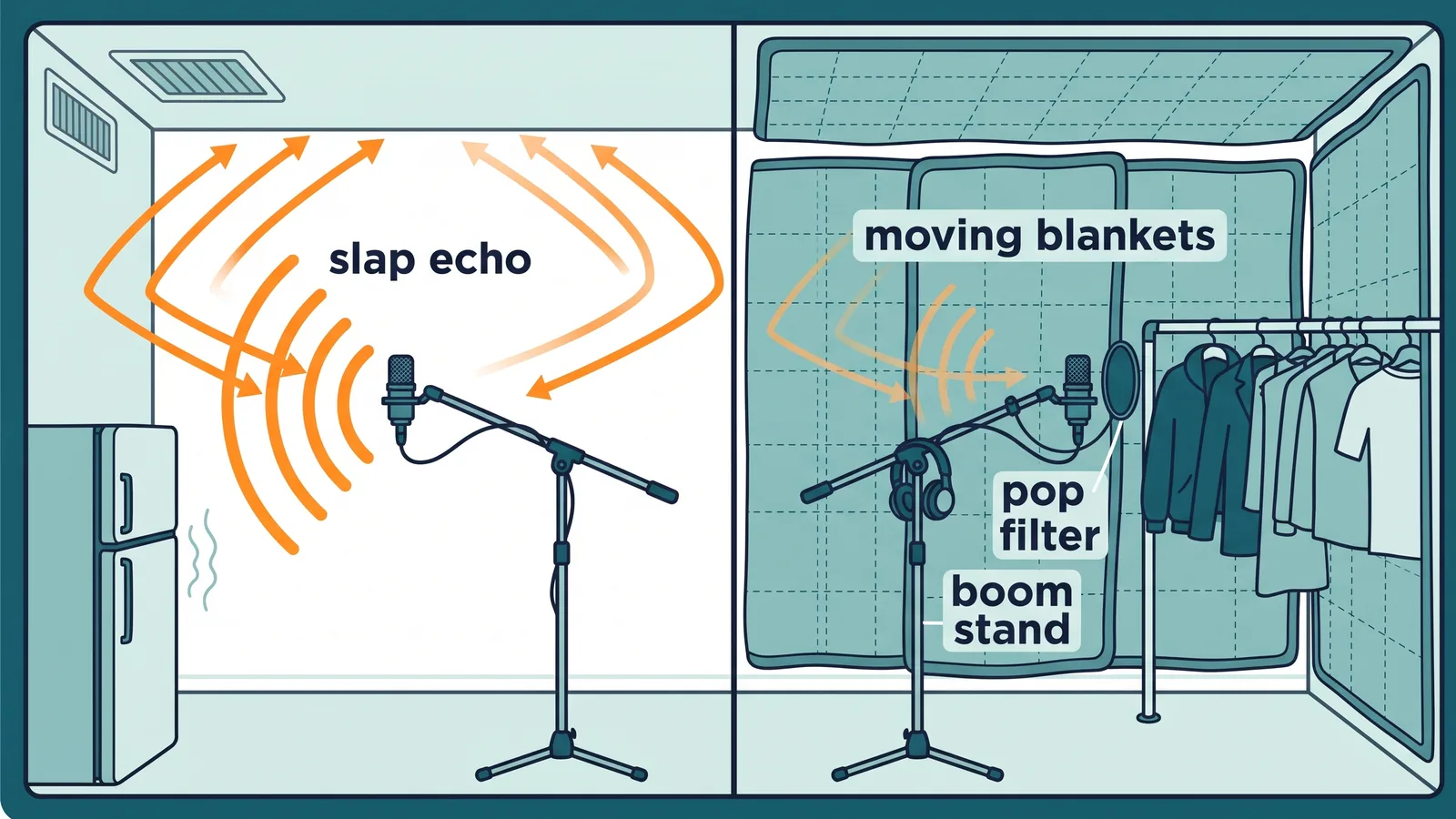
Time needed: one weekend for the space, two weeks for the demo. What you need: one large-diaphragm condenser or broadcast dynamic microphone, an audio interface, closed-back headphones, a boom stand, a pop filter, and soft mass — moving blankets, duvets, a clothes-filled closet.
Clients reject recordings for room sound long before they reject them for performance. Your goal is a dead, quiet space with no slap echo and no hum from a refrigerator, a vent or a laptop fan in the next room.
Test it this way: record 30 seconds of silence, raise the gain hard, and listen. If you hear traffic, HVAC or a ringing tail after you clap, add mass and soften surfaces before you add equipment.
Your demo is a casting tool, not an autobiography. Keep it short, lead with the read you are most castable for, and cut every segment that exists only to prove range you cannot repeat under direction.
Demo rules that hold up:
- Open with your strongest eight seconds. No music swell, no announcer intro, no name tag at the top.
- Use three to five distinct spots in one niche, not a tour of every genre.
- Write or license original copy. Recording a famous national spot invites a direct comparison you will lose.
- Get it mixed by someone who masters voice for broadcast; a great read in a muddy mix reads as amateur.
If you need a structural model for timing and pacing, this walkthrough of a 60-second explainer voice-over script with timings shows how copy maps to breath and beat.
Step 3 — Train the read: coaching, practice scripts and honest self-assessment
Time needed: 20 to 30 minutes of daily practice, plus one coaching session a month. What you need: a coach who currently books work, a folder of cold-read scripts, and recordings of your own takes from the last 30 days.
Coaching is the fastest correction loop available to a beginner, because you cannot hear your own habits. Choose a coach who works in your niche, asks what you want to book, and gives direction mid-session rather than praise at the end.
Practice material should be real copy with a real purpose: e-learning modules, product explainers, radio spots, nonfiction audiobook chapters. Read the same script three ways — informed, warm, urgent — and keep the version a client could actually use.
Run this self-assessment weekly on your own takes:
- Did you make a choice, or did you read neutrally and hope?
- Can you repeat take four after being asked for "less" or "faster"?
- Are your breaths placed where the copy makes sense, or where you ran out of air?
- Does the first sentence sound like someone talking to one person?
- Would you skip this if it played before a video you wanted to watch?
Record auditions you did not book, then listen a week later. That delay strips away the attachment and leaves you with usable notes.
Step 4 — Get in front of buyers: pay-to-play platforms, agencies and direct outreach
Time needed: two to four hours a week, every week. What you need: a finished demo, a one-paragraph bio, a rate sheet, and a tracked list of prospects.
Pay-to-play marketplaces are a visibility channel with a real cost. Voices.com charges $499 per year for its Premium talent membership, which is required to be auto-matched to jobs and to reply to them. Voice123 states that free members only receive project invitations after paying members have been invited, and its paid memberships start at $49.
Budget one platform at a time and measure it. If 90 days of auditions produce no bookings and no callbacks, the problem is usually the demo or the niche, not the subscription tier.
Agency submissions work differently. Send a short email with your niche, your demo link, your booth specs and your turnaround time — then follow their stated submission process exactly and wait without chasing.
Direct outreach closes more first jobs than beginners expect:
- Local video production companies and marketing agencies that post client work weekly
- E-learning developers and instructional designers hiring per module
- Podcast networks needing intros, ad reads and narration
- Regional radio stations and in-house brand teams
Keep the email under 120 words, name the specific project of theirs you watched, and attach nothing. One link, one sentence about availability, one close.
Step 5 — Quote rates, sign safely and add an AI/voice-cloning clause
Time needed: two hours to build a rate sheet, 15 minutes per contract review. What you need: an industry rate guide, a simple invoice template, and a standing clause you paste into every agreement.
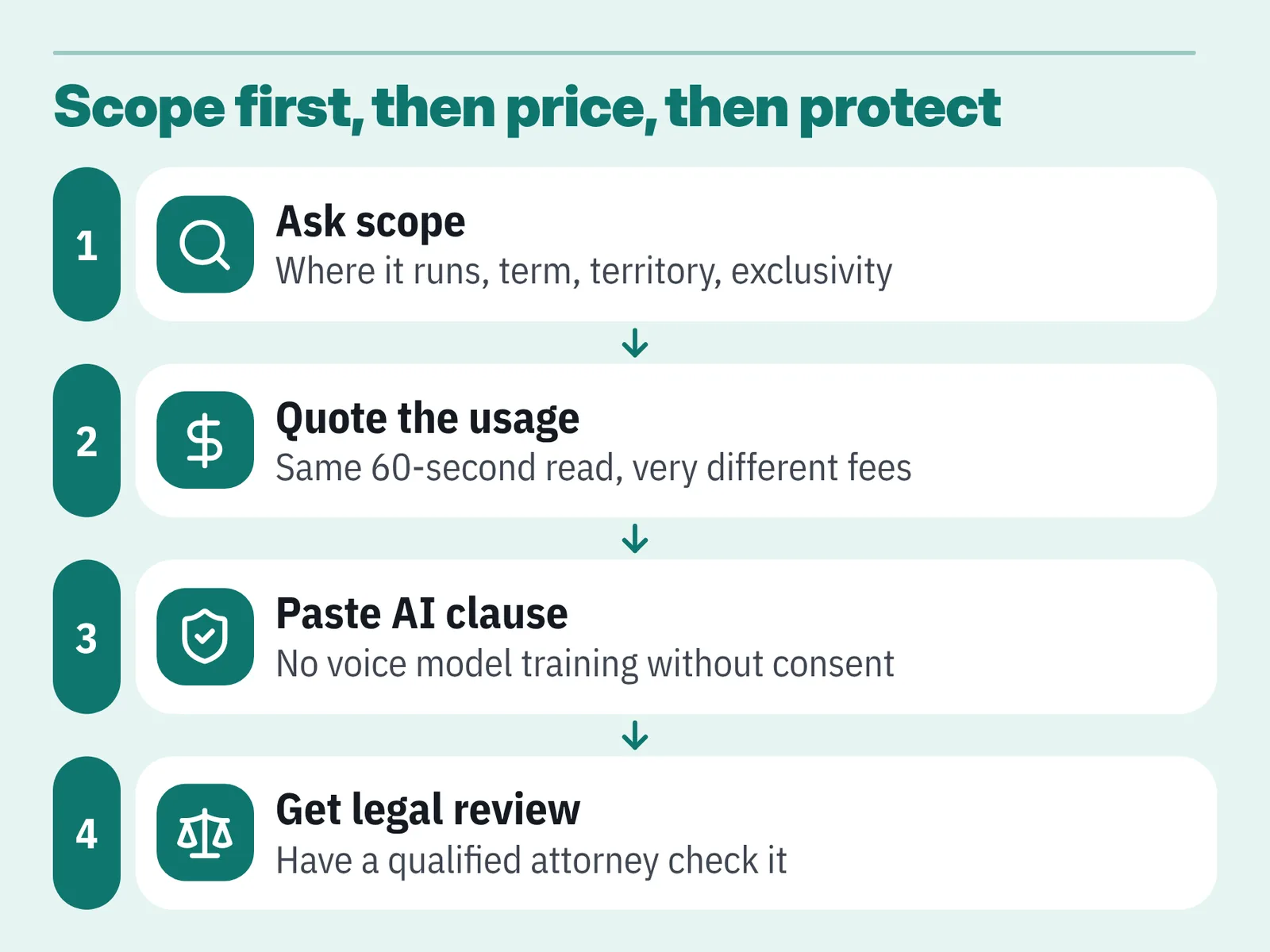
Never quote before you know the scope. Ask where it runs, for how long, in which territories, whether it is paid media or internal, and whether the client wants exclusivity in your category. The same 60-second read can be worth a modest session fee or several thousand dollars depending on those answers.
The U.S. Bureau of Labor Statistics reports the median hourly wage for actors — the occupational category that covers voice performers — was $23.33 in May 2024. Use that as a floor-setting reality check on the broader profession, not as a rate card for commercial usage.
Union work carries its own structure. Under SAG-AFTRA’s National Code of Fair Practice for Sound Recordings, the health and retirement contribution rate is 13% for both non-royalty and royalty work.
Your synthetic-voice clause should cover four things:
- Scope of use. The recording is licensed for the named deliverable only; synthetic replication of the voice is excluded.
- Training consent. No audio from the session may be used to train, fine-tune or create a voice model without separate written consent and separate compensation.
- Term and territory. Avoid perpetual, all-media grants unless the fee genuinely reflects a buyout.
- Deletion. Raw session files are deleted within a defined window after delivery.
Understanding the technology helps you negotiate it; this explanation of how zero-shot voice cloning builds a model from seconds of audio shows why "we just need the clean WAVs" is a scope question, not an admin one.
These points describe how US-based voice contracts are commonly written; contract and publicity rules differ by state, and clients in the UK, EU or Canada operate under different law. This is general information, not legal advice — have a qualified attorney review anything you are asked to sign.
Your first 90 days: a step-by-step checklist
Work the list in order. Skipping ahead to auditions with an untreated room is the most common way beginners burn their first impressions.
Weeks 1–2
- ☐ Choose one niche and name ten real buyers in it.
- ☐ Clear and soften a recording space; record a 30-second silence test.
- ☐ Buy one microphone and one interface. Nothing else yet.
Weeks 3–4
- ☐ Record 15 practice scripts in your niche; keep the three best.
- ☐ Book one coaching session and bring those three takes.
- ☐ Draft your rate sheet with usage questions written at the top.
Weeks 5–8
- ☐ Produce and professionally mix a 60 to 90 second demo.
- ☐ Build a one-page site with the demo, your booth specs and turnaround time.
- ☐ Join one paid casting platform and submit to five agencies.
Weeks 9–12
- ☐ Send 20 direct outreach emails per week and log every reply.
- ☐ Audition daily; archive every unbooked audition for review.
- ☐ Add your AI and voice-cloning clause to every agreement before signing.
- ☐ Review results at day 90: callbacks, bookings, and which channel produced them.
If day 90 arrives with zero callbacks, change one variable — usually the demo — and run another 30 days rather than quitting the plan entirely.
Common mistakes that keep beginners from booking their first job
The failure that stalls most newcomers: spending heavily on microphones and plugins while recording in an untreated bedroom, then publishing a demo that sounds boxy. Buyers hear the room in the first two seconds and never reach the performance. Fix it by spending on soft mass and coaching first, and treating gear as the last purchase, not the first.
Other patterns worth avoiding:
- Auditioning everywhere at once. Fifty generic submissions lose to ten tailored ones with a slate that references the brief.
- Quoting a flat hourly rate. Voice-over is priced on usage; an hourly quote hands away broadcast rights for studio-assistant money.
- Chasing range instead of castability. A demo with nine styles tells a casting director you have no lane.
- Ignoring turnaround. Clients who ask for same-day delivery hire whoever answers first, consistently.
- Signing broad AI grants to get the gig. A one-time fee for unlimited synthetic replication of your voice ends your rate ladder before it starts.
Track rejections like data. Three briefs in a row asking for a warmer, younger read is market feedback about your demo, and acting on it beats sending the same file for another month.
Frequently asked questions
Do I need an agent to start getting voice-over work?
No. Most beginners book their first paid jobs through direct outreach to local production companies, e-learning developers and podcast networks. Agents generally want to see a professional demo and existing bookings before they sign you, so build those first.
How much does it cost to start auditioning on casting platforms?
Costs vary by platform and tier. Voice123 states that its paid memberships start at $49, while Voices.com charges $499 per year for its Premium talent membership, which is required to be auto-matched to jobs and to reply to them. Budget one platform at a time and measure callbacks for 90 days.
Is AI really taking entry-level voice-over jobs?
It has taken much of the low end. In the independent State of Voice Acting survey of working voice actors published by Voice Crafters, 73.9% said they had definitely or probably lost work to AI, and 39.8% said definitely. Performance-heavy niches remain the safer entry point.
Is audiobook narration a realistic first niche?
It can be, if you understand the hours. Backstage reports that new audiobook narrators typically need about 10 hours of work to deliver one finished hour of audio, versus about six hours for experienced narrators, so a low per-finished-hour offer can pay below minimum wage in practice.
Should I ever let a client train an AI voice model on my recordings?
Only with separate written consent and separate compensation, a defined term and territory, and a deletion clause for raw session files. Treat a blanket perpetual grant as a sale of your future rate, not a bonus. This is general information, not legal advice.
Sources
- Actors: Occupational Outlook Handbook, U.S. Bureau of Labor Statistics
- Stolen at the Audition: The State of Voice Acting Survey — Voice Crafters
- Premium Membership — Voices.com
- What are the membership options on Voice123? — Voice123 The Booth
- What Is PFH? Everything to Know About Per-Finished-Hour Rates — Backstage
- Sound Recordings at a Glance 2024 — SAG-AFTRA
This article was drafted with AI assistance and published by the Dubbing AI Editorial Team after its facts were checked against the sources listed above.