Netflix AI dubbing is mostly pipeline automation, not finished AI voice tracks: speech recognition, source simplification, machine translation and synthetic speech assist human localization teams, with dub-quality review and human talent still deciding what ships.
Quick steps to run a streaming-style AI dub
Streaming localization teams do not hand a film to one model and press go. They split the job into stages, automate the cheap ones, and keep humans on the expensive ones.
- Export a clean source transcript, then correct the ASR output by hand before anything else touches it.
- Simplify long or idiomatic source lines before translation, not after.
- Translate with a locked glossary and a do-not-translate list for names, products and legal terms.
- Generate synthetic voices only after timing has been fitted to the original cue sheet.
- Run a scored human QC pass and route every failed scene to human talent.
That order matters. Each stage inherits the errors of the one before it, so a mistranslated brand name becomes a mispronounced brand name becomes a re-record.
The sections below unpack what Netflix has actually confirmed, where AI plugs into a dubbing pipeline, and how to reproduce a scaled-down version of that workflow with a two-person team.
What "Netflix AI dubbing" actually means right now
Netflix has not announced a consumer-facing program that ships fully AI-generated dub tracks. What exists publicly is a research-and-tooling posture: machine learning applied to subtitle preparation, localization analytics and speech work, with human linguists and voice directors still in the chain.
The company has been open about generative AI inside production, though. Netflix co-CEO Ted Sarandos said the generative-AI-assisted VFX shot in "El Eternauta" was completed ten times faster than conventional methods and would otherwise have been unaffordable, as reported by The Decoder.
That statement is about visual effects, not voice. Treat it as evidence of appetite and internal tooling, not as proof that Netflix dubs are synthetic.
Most of what circulates online conflates three different things: AI-assisted subtitle translation, AI-assisted dub preparation, and AI-generated voice performance. Only the first two have visible footprints at the major streamers today.
If you are deciding between tracks for your own catalog, the trade-offs in when subtitles beat a dub for your audience apply at any budget, not just at streaming scale.
Inside a streaming dubbing pipeline: five stages where AI plugs in
A dubbing pipeline is a relay. Here is where automation realistically takes over, in order:
| Stage | What AI does | What humans still own |
|---|---|---|
| 1. ASR | Transcribes source audio with timecodes | Fixing names, overlaps, accents |
| 2. Source simplification | Shortens and de-idiomizes lines before translation | Approving meaning changes |
| 3. Machine translation | First-pass target script | Terminology, register, cultural calls |
| 4. Synthetic voice | Generates timed read for each character | Casting, performance notes, retakes |
| 5. Mix and QC | Aligns, ducks, normalizes loudness | Final listen, scoring, sign-off |
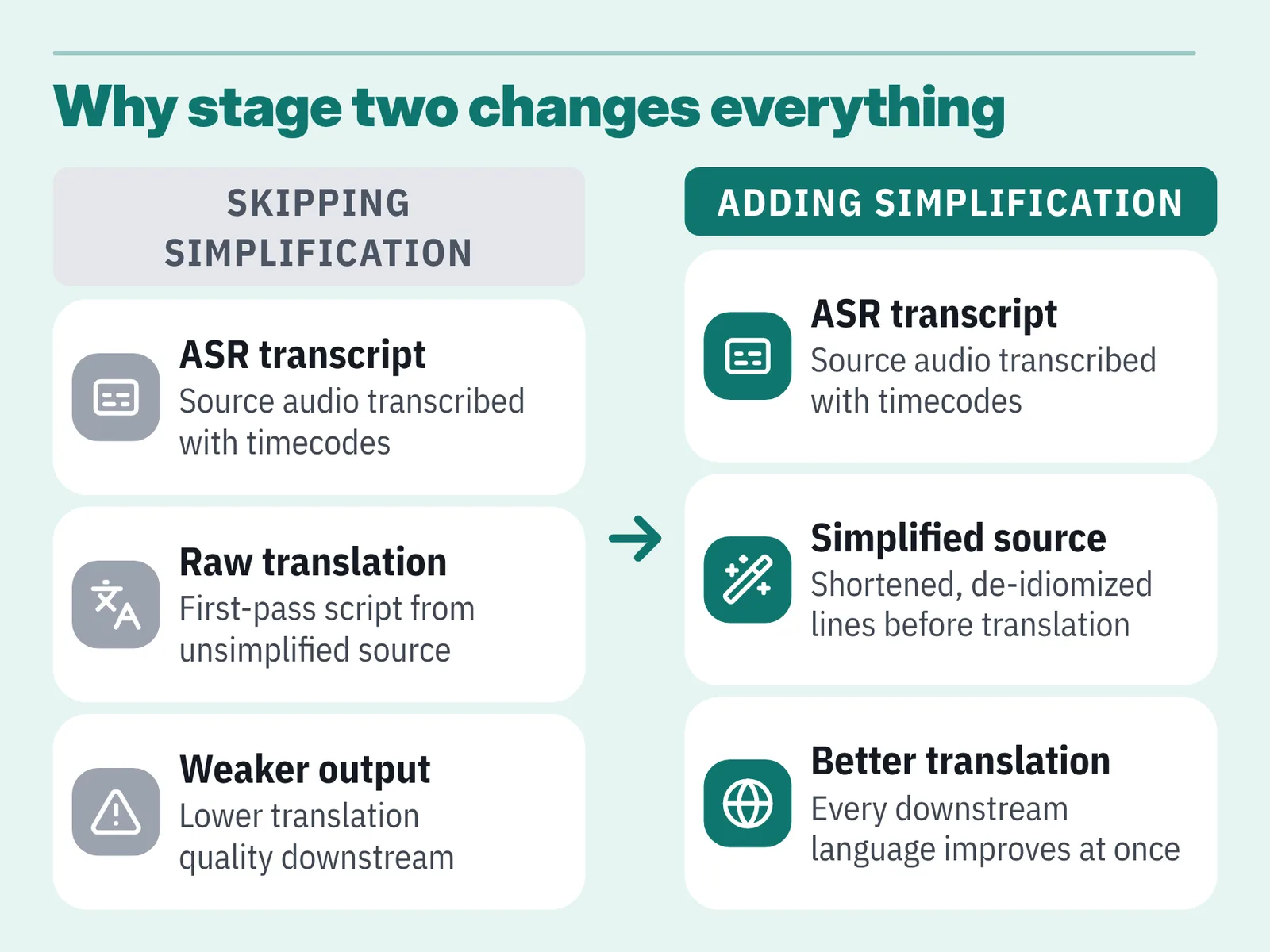
Stage two is the one most teams skip. Netflix machine-learning researchers tested automatic source-text simplification before machine translation across seven low-resource languages and found better translation quality from simplified source content, according to Slator.
That finding has a practical reading for you: fix the source, and every downstream language improves at once.
Stage four is where output quality collapses most visibly, usually through flat prosody and wrong emphasis rather than wrong words. The breakdown of what makes an AI dub sound wrong and how to fix it covers the common causes line by line.
The evidence trail: localization research and generative-speech hiring
Public hiring tells you where a streamer is investing before any product launch does. Netflix posted a localization research scientist role on March 21, 2025 within its Globalization Data Science and Engineering group in Los Gatos, according to CBR.
The advertised pay band for that Netflix generative-speech localization research role was $170,000 to $720,000, CBR reported.
A band that wide usually signals a senior research hire with equity, not a tooling contractor. Read it as a bet on speech generation research inside the globalization org.
The second signal is measurement. Streamers run localization analytics and dub-quality scoring because they need to compare a Korean dub in Brazil against a Spanish dub in Germany on the same scale.
You can copy that habit cheaply. Score every dub on the same rubric, store the scores next to completion rate for the dubbed track, and you will know which languages deserve human talent before you spend on it.
Prime Video’s 12-title pilot and its hybrid rule
Amazon’s Prime Video launched AI-aided dubbing in English and Latin American Spanish on an initial slate of 12 licensed movies and series, according to About Amazon.
The design choice matters more than the slate size. Prime Video’s AI dubbing pilot is explicitly a hybrid workflow in which human localization professionals work alongside the AI for quality control, as About Amazon describes it.
Trade coverage framed the commercial logic plainly: Slator reported that the pilot’s goal was opening the streamer’s library to its existing base of 200 million customers worldwide.
Three lessons transfer to a content team of any size:
- Pick titles that were never going to get a human dub. Licensed back-catalog, not flagship originals.
- Name the human role explicitly. "QC reviewer" is a job with a checklist, not a vague safety net.
- Limit the language pairs. Two languages done well beats twelve done once.
AI dubbing earns its place on the long tail first. That is the pattern the public pilots keep repeating.
Scenario: a 6-episode Spanish course series into English
Example: a training team has six Spanish-language course episodes, roughly 20 minutes each, and one English-speaking instructor who can review but not re-record.
The old route was a full studio dub: transcription vendor, translation vendor, casting, a booth day, then a mix. The AI-assisted route keeps the same checkpoints and removes the booth.
| Workflow step | Before (studio dub) | After (AI dub + human QC) |
|---|---|---|
| Transcript and translation | Vendor hand-off, two rounds | In-house ASR, edited in place |
| Voice production | Casting plus booth session | Generated per episode, revised on request |
| Review | Director in session | Scored QC pass, async |
| Hand-offs | 4 external parties | 1 internal reviewer |
Planning estimate, not a measured result: budget around 12 hours of internal work per episode for the studio route versus about 3 hours for the AI-assisted route, with the saved time moving into QC. Use your own first episode to replace those numbers.
The gating factor is rarely generation speed. It is how fast your reviewer can watch, score and return notes, which is why a comparison of cost and turnaround across video translation options is worth running before you commit a series.
The reproducible procedure: a 9-step AI dub with human QC
Run this on one episode before you scale it to a season:
- Lock the source cut. No re-edits after this point, or every timing decision resets.
- Transcribe with ASR, then correct by hand. Names, numbers and overlapping speech first.
- Simplify the source script. Shorten run-on lines and replace idioms that will not survive translation.
- Translate with a glossary and a do-not-translate list for brands, product names and legal phrases.
- Fit the translation to timing. Match syllable load to the original cue length before any audio exists.
- Choose or clone voices with written consent on file. Platforms such as AI Studios offer text-to-speech in 150+ languages and accents on paid plans plus voice cloning from a short recording, per AI Studios’ plan details.
- Generate scene by scene, not in one pass, so a single bad read does not force a full regeneration.
- Mix properly. Duck music and effects, match room tone, normalize to your platform’s loudness target.
- Score the QC pass and escalate failures to a human voice actor for the scenes that fail.
Keep step 3 ahead of step 4. Reordering those two is the single most common reason a multi-language batch comes back uneven.
Quality gates streamers use that you should copy
Scale forces measurement. YouTube generated dub tracks in more than 40 languages for 3,500 videos during its auto-dubbing test phase before the feature was widened, according to Tubefilter — a volume no team reviews by instinct alone.
YouTube said it had made auto dubbing available to hundreds of thousands of YouTube Partner Program channels focused on knowledge and information, as reported by Social Media Today.
Score every dubbed episode on four axes, pass or fail:
- Accuracy: meaning preserved, numbers and names correct.
- Naturalness: stress and pauses match how a person would say the line.
- Sync: speech starts and ends inside the original cue.
- Mix: dialogue intelligible over music and effects at low volume.
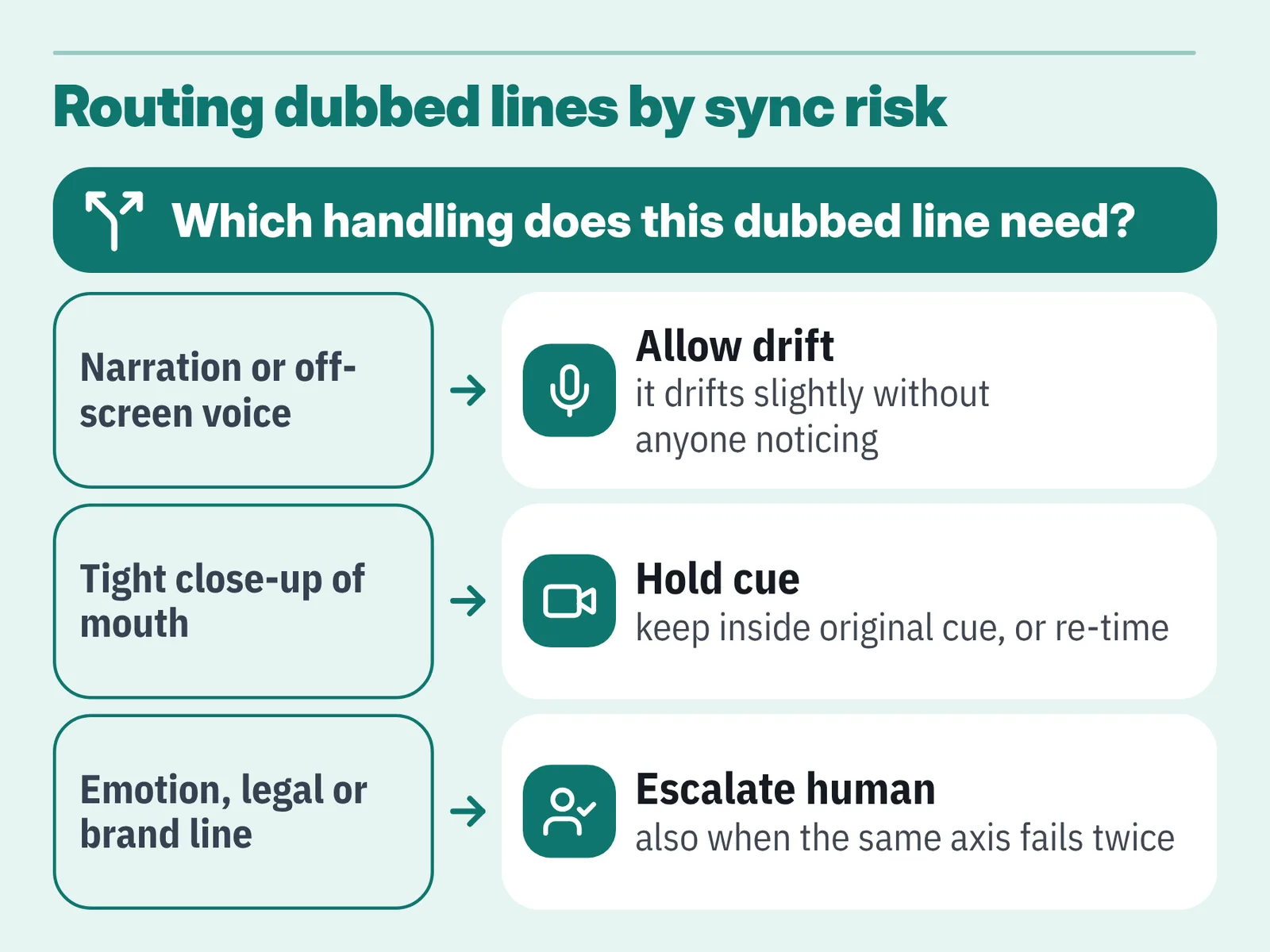
For lip-sync tolerance, split your content. Narration and off-screen voice can drift slightly without anyone noticing; a tight close-up of a speaking mouth cannot, so hold those lines to the original cue boundaries or re-time the shot.
Escalate to human talent when a scene carries emotion, a legal disclaimer, a brand-critical line, or fails the same axis twice. Voice provenance questions come up often here, and how reliable AI voice detectors actually are is a useful reality check before you promise clients anything about detectability.
Consent, contracts and credits
Voice cloning is a permissions problem before it is a technical one. Get written, specific consent that names the voice owner, the titles, the languages, the term, and whether the model may be reused on future projects.
Rules differ by jurisdiction. In the United States, voice and likeness protections vary state by state; in the EU, transparency obligations around synthetic media apply alongside data protection law; and in many dubbing markets, collective agreements with voice actors set separate terms.
Disclosure is the cheapest risk control you have. A line in the credits or description stating that a track was produced with AI assistance and reviewed by human localization professionals costs nothing and preempts the accusation.
Premium content still has a ceiling. Lead performances, comedy timing and anything where a recognizable actor’s voice is part of the brand belong with human talent, and the technical reasons are explained well in how zero-shot voice cloning actually works.
This section is general information, not legal advice; check your contracts and local law with a qualified attorney before cloning any voice.
Frequently asked questions
Does Netflix use AI to dub its shows?
Netflix has not announced a program that ships fully AI-generated dub tracks. It has used generative AI in production, and Ted Sarandos said the AI-assisted VFX shot in "El Eternauta" was completed ten times faster than conventional methods, The Decoder reported.
What proof is there that Netflix is working on AI dubbing?
The clearest public signal is hiring. Netflix posted a localization research scientist role on March 21, 2025 in its Globalization Data Science and Engineering group in Los Gatos, with an advertised pay band of $170,000 to $720,000, according to CBR.
Which streaming platform has publicly launched AI dubbing?
Prime Video. Amazon launched AI-aided dubbing in English and Latin American Spanish on an initial slate of 12 licensed movies and series, and About Amazon describes it as a hybrid workflow with human localization professionals handling quality control.
Where does AI actually help most in a dubbing pipeline?
Before translation. Netflix machine-learning researchers tested automatic source-text simplification ahead of machine translation across seven low-resource languages and found better translation quality from simplified source content, Slator reported, which means fixing the source improves every target language at once.
When should I still hire a human voice actor?
Escalate any scene carrying emotion, comedy timing, legal disclaimers, or a brand-critical line, plus any scene that fails the same quality axis twice. Lead performances on premium content remain human work, and tight lip-sync close-ups rarely survive synthetic timing.
Sources
- World’s Biggest Anime Streamer Explores AI Subs & Dubs in New Job Posting Reveal — CBR
- Netflix used generative AI to create a VFX scene in its series ‘El Eternauta’ — The Decoder
- Prime Video begins an AI dubbing pilot program on licensed movies and series — About Amazon
- Amazon Prime Video Launches AI Dubbing Pilot — Slator
- YouTube says hello, hola, and नमस्ते by expanding auto-dubbing to educational creators — Tubefilter
- YouTube Expands Access To Auto-Dubbing in Different Languages — Social Media Today
- How Netflix Researchers Simplify Subtitles for Translation — Slator
This article was drafted with AI assistance and published by the Dubbing AI Editorial Team after its facts were checked against the sources listed above.