Zero-shot voice cloning copies a voice the model never trained on: your short clip is encoded as a voice prompt, a codec language model predicts speech tokens from your script, and a decoder rebuilds the waveform.
What zero-shot voice cloning actually means (and why "zero-shot" is the key word)
Definition: Zero-shot voice cloning produces speech in a voice the model was never trained on, using one short reference clip supplied at generation time instead of a retraining run.
"Zero-shot" is borrowed from machine learning, where it describes a model handling a category it saw zero examples of during training. Here the category is a person. The system has never heard you, holds no file labeled with your name, and still speaks in your voice.
Zero-shot text-to-speech is defined in the research literature as synthesizing speech for speakers the model has never seen, using only a short enrolled speech sample at inference time, according to Microsoft’s VALL-E 2 paper on arXiv.
The neighboring idea people mix it up with is voice conversion. The difference is what you feed in:
- Zero-shot cloning takes a text script plus a reference clip, then writes a new performance from scratch.
- Voice conversion (speech-to-speech) takes someone’s actual recorded performance and repaints the timbre, keeping the original timing and delivery.
- Stock TTS voices ship inside the model and need no reference clip at all.
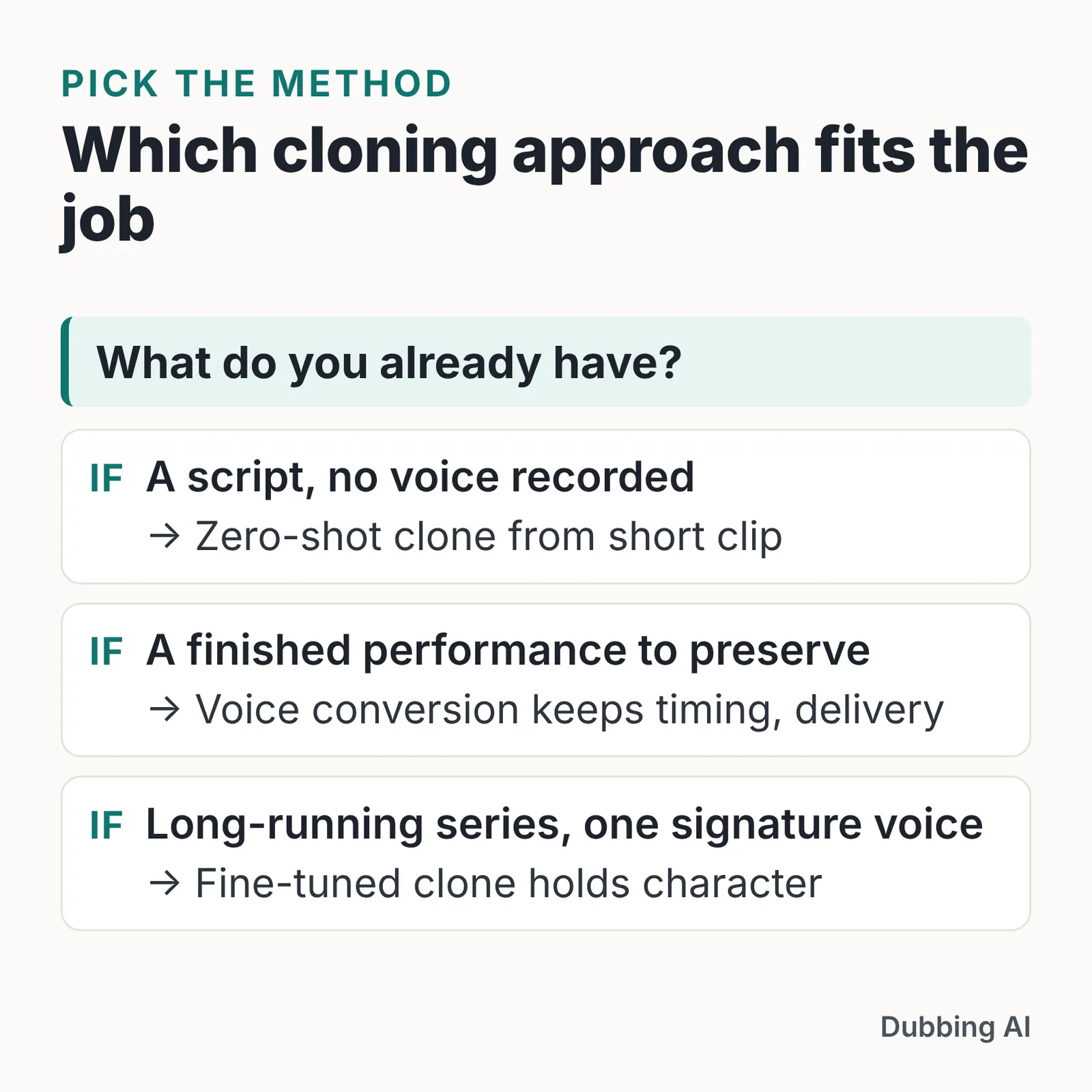
Pick based on what you already have. A finished performance you want preserved points to conversion; a script that still needs a voice points to zero-shot cloning.
Stage 1: Turning a few seconds of reference audio into a voice representation
The first thing a system does with your clip is turn it into something the generator can condition on. Two designs dominate. One extracts a fixed speaker embedding — a compact vector that summarizes timbre. The other encodes the clip into the same discrete audio tokens the model will later produce, then keeps that sequence as a prompt sitting in front of your script.
Microsoft Research states that VALL-E can synthesize personalized speech for an unseen speaker from only a 3-second enrolled recording used as an acoustic prompt.
That works because the heavy learning already happened before you arrived. VALL-E’s zero-shot ability came from pre-training on LibriLight, a corpus of more than 60,000 hours of English speech from over 7,000 speakers, according to Voicebot.ai. Your clip selects a point in a space the model already mapped.
Your reference carries more than timbre. It carries pitch range, speaking rate, accent, mic coloration, room reverb and any background hum sitting under the words.
Record two or three plain sentences in the space where you normally work, mono, with no music bed and nobody else speaking. A clip recorded over air conditioning will clone the air conditioning too.
Stage 2: Predicting speech tokens with a neural codec language model
A neural audio codec compresses a waveform into discrete tokens — think of a vocabulary of short sound fragments rather than raw samples. The language model then predicts those tokens one after another, conditioned on the phonemes from your script and on the tokens from your reference clip. Nothing is copied and pasted; every frame is predicted.
In the June 2024 VALL-E 2 paper, Microsoft researchers claim the first zero-shot text-to-speech system to reach human parity.
Token prediction involves sampling, so two runs of the same sentence will differ in breath placement, emphasis and micro-timing. That is why a re-render rarely matches a take you already approved.
The classic failure mode of this architecture is a skipped or repeated word on long, awkward or symbol-heavy input. Treat the script as part of the model’s input, not as an afterthought.
Split copy into sentence-sized chunks, expand abbreviations, spell out numerals the way you want them spoken, and mark hard proper nouns phonetically. A tight script draft like the one in this 60-second explainer voice-over script walkthrough gives the model fewer chances to stumble.
Stage 3: Decoding tokens back into a natural-sounding waveform
The codec’s decoder reverses stage two: it reads the predicted token sequence and reconstructs audio samples you can actually play. Quality here depends on the codec, not on your clip. A strong language model paired with a weak decoder still sounds brittle.
Artifacts cluster in predictable places. Sibilance turns metallic, consonants smear at the end of fast lines, breaths get clipped into clicks, and the final word of a sentence sometimes fades early.
The decoder also reproduces whatever acoustic space your reference clip lived in. Record in a tiled kitchen and the dub arrives with that room attached, which no amount of prompt tweaking removes.
Check every render twice: once on headphones for sibilance and breath, once on a phone speaker for muddiness and missing low end. Listen to the first second and the last second closely, since those are where truncation shows up.
If the output sounds flat or plasticky rather than wrong, the fix is usually upstream — reference clip, script punctuation, pacing. A walkthrough of the usual causes behind bad-sounding AI dubs covers the ones that recur most in production work.
How much audio you really need: platform limits from 3 seconds to 2 minutes
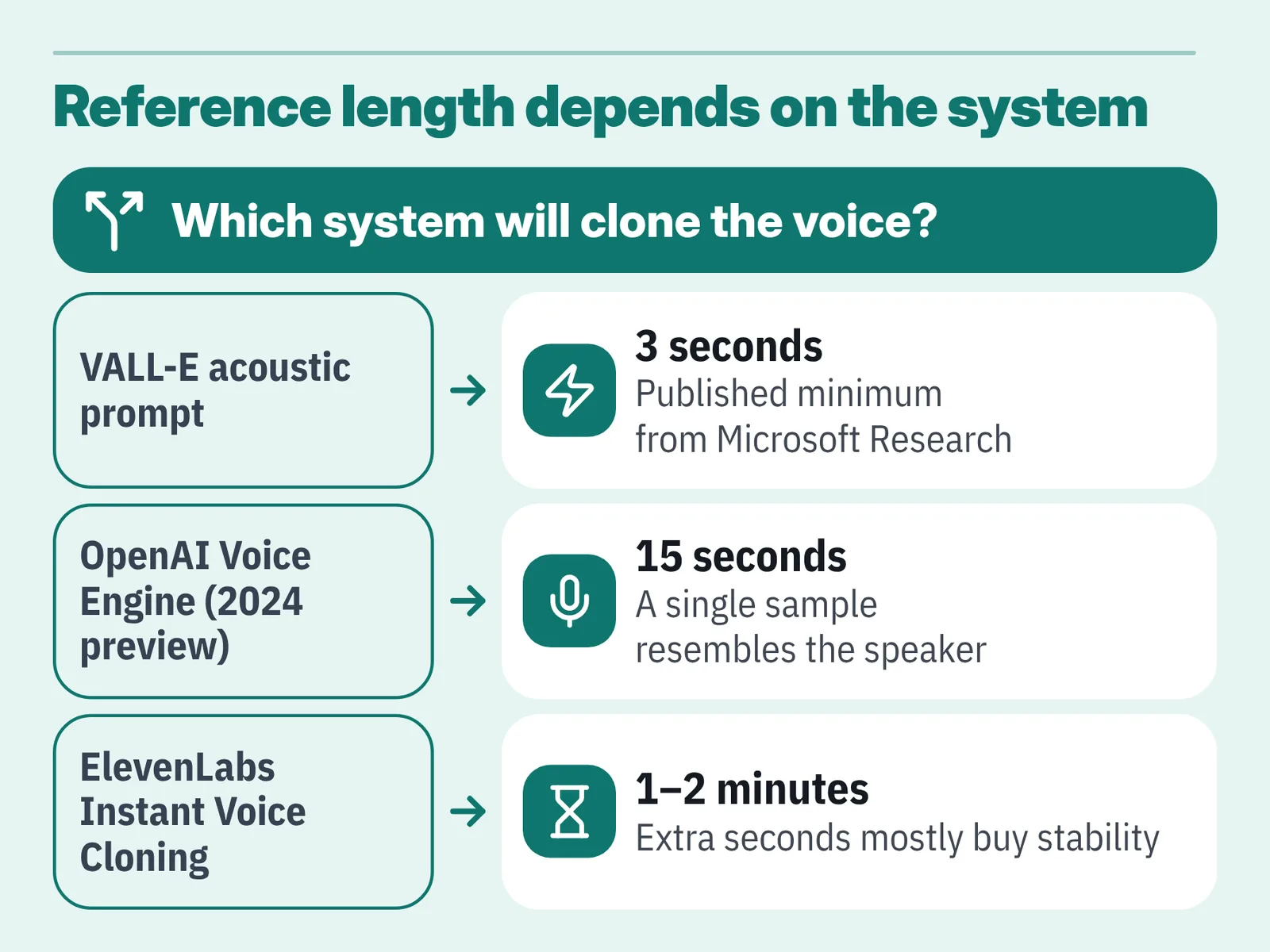
Minimums differ by system, and the published figures span two orders of magnitude.
| Reference length | System | Source |
|---|---|---|
| 3 seconds | VALL-E acoustic prompt | Microsoft Research |
| 15 seconds | OpenAI Voice Engine (2024 preview) | Inquirer Technology |
| 1–2 minutes | ElevenLabs Instant Voice Cloning | ElevenLabs docs |
OpenAI’s Voice Engine, previewed in 2024, generates speech resembling a speaker from a single 15-second audio sample, according to Inquirer Technology.
A minimum is not a recommendation. Give the system more than it asks for when you can, because extra seconds mostly buy stability — fewer odd vowels, steadier pacing, less drift across a long render.
Match the register too. A reference clip recorded in a bright, upbeat tone will not deliver a somber compliance module convincingly, no matter how clean the audio is.
If you are evaluating self-hosted options with different input requirements, the roundup of free local text-to-speech models you can run yourself is a useful companion to the hosted services above.
Zero-shot vs. fine-tuned (professional) voice cloning: quality, time and cost trade-offs
Fine-tuned cloning updates model weights on your voice. Zero-shot cloning leaves the model untouched and conditions it at generation time. The practical gap shows up in three places.
| Zero-shot (instant) | Fine-tuned (professional) | |
|---|---|---|
| Audio required | Seconds to a couple of minutes | 30 to 180 minutes (ElevenLabs) |
| Wait before first render | None | 3–6 hours of training (ElevenLabs) |
| Best fit | Pilots, pickups, many languages fast | Long-running series, one signature voice |
ElevenLabs documentation recommends 1 to 2 minutes of audio for Instant Voice Cloning but 30 to 180 minutes for Professional Voice Cloning.
Unlike instant cloning, an ElevenLabs Professional Voice Clone must be fine-tuned, a process that usually takes 3 to 6 hours before the voice is ready, per the same documentation.
Consistency is the real dividing line. Across a 40-episode course, small zero-shot variations accumulate into a voice that subtly shifts between modules, while a fine-tuned clone holds its character.
Cost follows effort: recording and submitting a long dataset costs studio time and scheduling, and that only pays back when the voice will be reused for months.
Where zero-shot cloning fits in dubbing, video translation and course localization
Zero-shot cloning earns its place wherever speed and breadth beat perfection. Market-testing a course in four languages before committing budget. Replacing a product name that changed in module nine. Narrating weekly updates when the original narrator is unavailable.
It is also the fastest way to answer a stakeholder question: does this course even work in Portuguese? You can hear a rough answer the same afternoon.
Two places it tends to disappoint: emotionally dense dramatic performance, and singing. Both depend on control the model does not take instruction on.
Language coverage is a separate question from voice coverage. A clone of your voice does not guarantee correct pronunciation or prosody in a target language, which is why pitch-accent-heavy languages need their own review pass.
When you are costing out a localization run, compare the cloning step against the whole pipeline using this breakdown of video translation services on cost and turnaround, since voice is only one line item next to timing, QC and subtitles.
Consent, disclosure and compliance: what creators must get right before publishing
The technical minimum — three seconds of audio — is far below the ethical minimum. Treat a reference clip the way you would treat a signed talent release, because that is what it functions as.
The US Federal Trade Commission announced four winners of its Voice Cloning Challenge, run to address present and emerging harms of AI-enabled voice cloning. There is no single federal US statute covering synthetic voice in media; state laws on likeness and publicity rights differ, so check the states where you record and publish.
In the European Union, transparency obligations covering deepfakes and synthetic audio in Article 50 of the EU AI Act apply from 2 August 2026, according to European Commission guidance — and that date has now passed. Those duties fall on providers and deployers of the systems within the Act’s scope, not on viewers.
Before you publish a cloned voice, lock down four things:
- Written consent naming the speaker, the languages, the content types and the term.
- Storage of the reference clip alongside the consent record, so you can prove which audio produced which render.
- Disclosure in the video description or an on-screen note, in plain language.
- Revocation: an agreed process for deleting the voice and pulling renders if consent is withdrawn.
For spot checks on third-party footage, read what AI voice detectors actually achieve on benchmarks before you rely on a verdict.
This section is general information about rules in the US and EU, not legal advice; confirm obligations with counsel in your jurisdiction.
Frequently asked questions
How many seconds of audio does zero-shot voice cloning really need?
It depends on the system. Microsoft Research says VALL-E works from a 3-second enrolled recording, OpenAI’s previewed Voice Engine uses a single 15-second sample per Inquirer Technology, and ElevenLabs documentation recommends 1 to 2 minutes for Instant Voice Cloning. Supply more than the minimum for steadier output.
Why is it called "zero-shot" if the model clearly learned from audio?
The zero refers to examples of your voice, not to training in general. Voicebot.ai reports VALL-E was pre-trained on LibriLight, more than 60,000 hours of English speech from over 7,000 speakers, and your clip simply steers that pre-trained model at generation time.
Is zero-shot cloning good enough for a full course or series?
For pilots, pickups and short updates, yes. Across dozens of modules, small run-to-run variations accumulate and the voice drifts. ElevenLabs documentation recommends 30 to 180 minutes of audio for Professional Voice Cloning, which is fine-tuned over roughly 3 to 6 hours before it is ready.
What is the difference between zero-shot cloning and voice conversion?
Zero-shot cloning starts from a written script plus a short reference clip and generates a brand-new performance. Voice conversion starts from an existing recorded performance and changes only the timbre, keeping the original timing, emphasis and emotional delivery intact.
Do I have to disclose that a voice in my video is cloned?
In the European Union, transparency obligations for deepfakes and synthetic audio under Article 50 of the EU AI Act apply from 2 August 2026 according to European Commission guidance. US rules vary by state, so disclose clearly and get written consent regardless. This is general information, not legal advice.
Sources
- VALL-E 2: Enhancing the robustness and naturalness of text-to-speech models — Microsoft Research
- VALL-E 2: Neural Codec Language Models are Human Parity Zero-Shot Text to Speech Synthesizers (arXiv:2406.05370)
- VALL-E 2: Neural Codec Language Models are Human Parity Zero-Shot Text to Speech Synthesizers (arXiv HTML)
- Microsoft Debuts 3-Second Voice Cloning Tool VALL-E — Voicebot.ai
- OpenAI Voice Engine clones voices from 15-second clips — Inquirer Technology
- Professional Voice Cloning — ElevenLabs Docs
- Voice Cloning overview — ElevenLabs Docs
- Approaches to Address AI-enabled Voice Cloning — Federal Trade Commission
- Guidelines on transparency obligations for providers and deployers of certain AI systems — European Commission
This article was drafted with AI assistance and published by the Dubbing AI Editorial Team after its facts were checked against the sources listed above.