Subtitles usually win for reach and retention: they are cheaper, faster, preferred by most US viewers — 80% to 20% in Preply’s survey, peaking at 85% on social media — and they work in sound-off feeds. Dubbing earns its cost for visual-heavy, long-form or dubbing-first-market content.

Subbing vs dubbing: what each term actually means
> Definition: Subbing adds translated text on screen while the original audio keeps playing. Dubbing removes that original dialogue and replaces it with a new recorded performance in the target language, timed to the picture.
The short answer, before the detail:
- Subtitles win when your audience skews under 30, watches in sound-off feeds, or when the original performance is part of the value.
- Dubbing wins when the viewer’s eyes must stay on the action, when the content is long-form and must be completed, or when the market expects native-language audio.
Both routes solve one problem — a viewer who does not speak your source language — with opposite costs. Subbing spends the viewer’s attention. Dubbing spends your budget and your production calendar.
Three labels cover most of what localization teams actually ship:
- Subbing (subtitling): translated dialogue as timed on-screen text, original voices untouched.
- Dubbing: a full replacement audio track, lip-synced or phrase-synced, with original dialogue stripped from the mix.
- Voice-over / partial dub: a narrator track laid over lowered original audio, standard in documentaries, news packages and corporate explainers.
Kapwing reports that 61% of people who localize content use translated subtitles, versus 12% who use dubbing. That gap tells you which route is the industry default and which one needs a written business case before it gets approved.
Anime fans coined the "subs vs dubs" argument decades ago. Localization managers inherited it with far bigger budgets attached and far less patience for taste debates.
How each route gets made, from transcription to timing or voice recording
The two pipelines share their front half and split only at the final stage. Three stages, in order:
- Transcription and timecoding. A verbatim source transcript is built with in and out points for every line, including speaker labels and any on-screen text that matters to comprehension.
- Translation and adaptation. A linguist rewrites the transcript for the target market — compressing for subtitle reading speed, or rewriting for mouth shapes and syllable count if the line will be spoken.
- Delivery. Subtitles get timed, line-broken and exported as SRT or VTT; dubs get cast, recorded, edited against the picture and remixed with the original music and effects stems.
Stage two is where the two routes stop being the same job. Subtitle adaptation cuts words so a reader can keep up with the shot. Dub adaptation keeps the syllable rhythm so the mouth and the sound do not fight each other.
The mix is the hidden dependency nobody schedules for. If your source video has no separated music-and-effects stem, a dub either loses the original sound design or needs it rebuilt from scratch.
Subtitles, closed captions and voice-over: the terms teams mix up
The single most expensive confusion is treating closed captions and translated subtitles as one deliverable. They serve different people and need different source text.
| Format | Audio heard | Text on screen | Built for |
|---|---|---|---|
| Subtitles (translated) | Original language | Target-language dialogue | Viewers who do not speak the source language |
| Closed captions (SDH) | Original language | Same-language dialogue plus speaker IDs and sound cues | Deaf and hard-of-hearing viewers, sound-off scrollers |
| Voice-over | New narrator over quiet original | Optional | Documentary, news, training content |
| Dubbing | Replacement track only | Optional forced narratives | Viewers who expect native-language audio |
Captions describe the whole audio track: a door slamming, a phone buzzing, who is speaking off-camera. Subtitles only carry dialogue meaning. A vendor quoting "captions" when you asked for "subtitles in six languages" is quoting a different job.
Voice-over sits awkwardly between the two and is often the cheap compromise. You keep a trace of the original speaker’s emotion while delivering full comprehension, and you skip lip-sync entirely.
When subtitles win for reach and retention
In Preply’s survey of US viewers, Americans preferred subtitles over dubbing by 80% to 20% for foreign-language content. That preference is not a niche cinephile position. It holds across the places your content actually lives.
Preply found the subtitle preference peaks on social media at 85%, with 80% on streaming services and 78% on cable TV. Short-form feeds autoplay muted, so text is the only version of your message that lands in the first second.
Age skews the decision further. Preply reports that 94% of Gen Z and 80% of Millennials prefer subbing over dubbing, and YouGov found that 63% of US adults under 30 prefer watching TV with subtitles turned on. If your course buyers or product users are under 35, subtitles are closer to a format expectation than an accessibility add-on.
Context matters as much as preference. Preply’s subtitle survey found that 57% of surveyed Americans watch content in public, rising to 74% among Gen Z — trains, waiting rooms, open-plan offices, all places where audio is off by default.
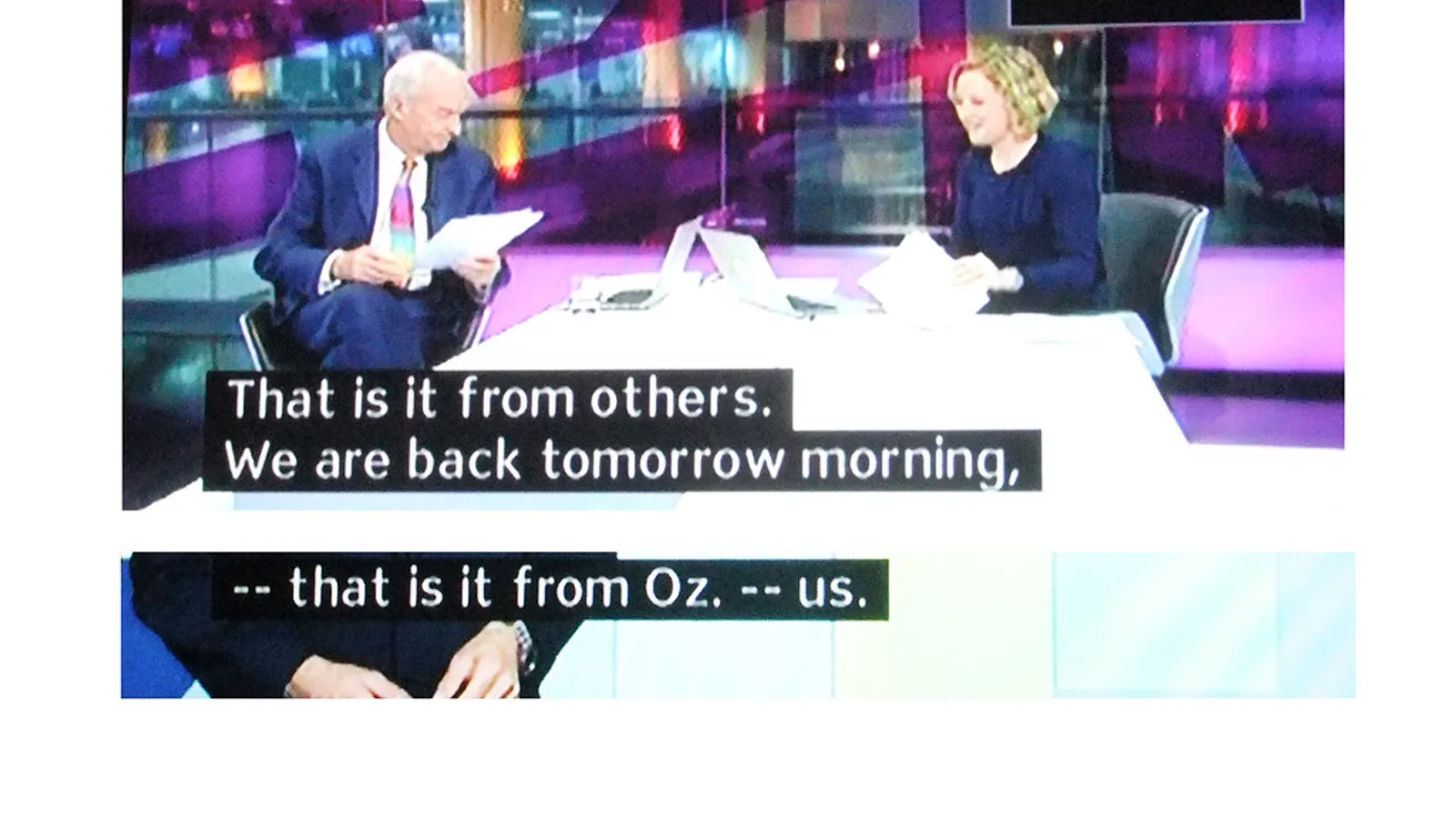
Subtitles also protect your original performance. A founder’s accent, a chef’s pacing, an instructor’s enthusiasm — none of it survives a mediocre dub, and all of it survives a good subtitle file.
When dubbing is worth the cost
Dubbing earns its budget whenever reading competes with watching. Product demos, software walkthroughs, surgical technique videos, cooking content, children’s programming: if the viewer’s eyes must stay on the action, subtitles steal the exact attention you need.
Long-form is the second trigger. A 40-minute compliance module or a multi-hour course asks for sustained reading that most learners quietly abandon, and completion rates are the metric course creators get judged on.
Market convention is the third, and this one is industry rule of thumb rather than survey data. Germany, France, Italy, Spain and much of Latin America are conventionally treated as dubbing-first markets, with long-established dubbing industries and audiences raised on dubbed theatrical releases, so a subtitled-only release there can read as unfinished rather than authentic.
There is a quieter signal in the data too. YouGov found that for TV in a language they already know, 53% of Americans prefer subtitles off while 38% prefer them on — meaning native-language audio still wins when comprehension is not the problem.
AI dubbing changed the math for mid-budget libraries. Platforms such as AI Studios offer text-to-speech voiceovers in 150+ languages and accents on paid plans, which makes a 30-language test release possible where a casting-and-booth model would never clear finance. The limits are real, though: synthetic voices still struggle with emotional range, children’s content and lip-sync on close-ups, so keep human casting for flagship material.
Cost, turnaround and quality control: what to budget for each route
Subtitles cost roughly one job: translate, time, proof, export. Dubbing costs at least four: adapt, cast, record, mix — and every one of them can send the file back a step.
Budget for these line items before you pick a route:
- Subbing: transcription, translation, timing, reading-speed QC, burned-in versions for social, per-language file management.
- Dubbing: adaptation, casting and voice approval, studio or synthetic voice generation, sync pass, music-and-effects remix, native-speaker listen-through.
- Both: glossary and do-not-translate list, on-screen text handling, a named reviewer per language.
Audio quality is now a visible risk, not a nice-to-have. Preply’s subtitle survey found that 55% of surveyed Americans say it is harder to hear dialogue in shows and movies than it used to be, which means a muddy dub mix will be noticed and blamed.
Quality control differs by route. Subtitle QC is a reading test: can someone finish each line before the cut? Dub QC is a listening test: does the voice match the face, the age, the room and the emotion.
Build one review loop per language with a named native speaker who signs off. Anonymous vendor QA is how a mistranslated product name ships to a whole market before anyone internally notices.
Platform, accessibility and compliance checks before you choose
Run these checks before the format debate, because they can eliminate an option outright.
- Platform support: YouTube and most LMS platforms accept multiple subtitle tracks and multiple audio tracks; many social feeds accept neither and force burned-in text.
- Accessibility: captions serve Deaf and hard-of-hearing viewers; a dub alone does not. Dubbing never replaces a caption obligation.
- Search and discovery: subtitle files give platforms indexable text, which dubs do not.
- Rights: check whether your voice talent contract or your music license covers derivative language versions.
A 2025 AP-NORC survey from the University of Chicago, cited by Kapwing, found that 33% of Americans use subtitles always or often — a baseline audience that exists whether or not you commission a dub.
In the United States, FCC rules apply captioning obligations to television programming redistributed online, and Title III of the ADA has been applied to some public-facing digital content; in the European Union, the European Accessibility Act sets requirements for in-scope services. Obligations differ by jurisdiction, sector and whether you are a public body or a private company. This is general information, not legal advice — confirm your specific obligations with counsel.
A decision workflow for content teams, course creators and localization managers
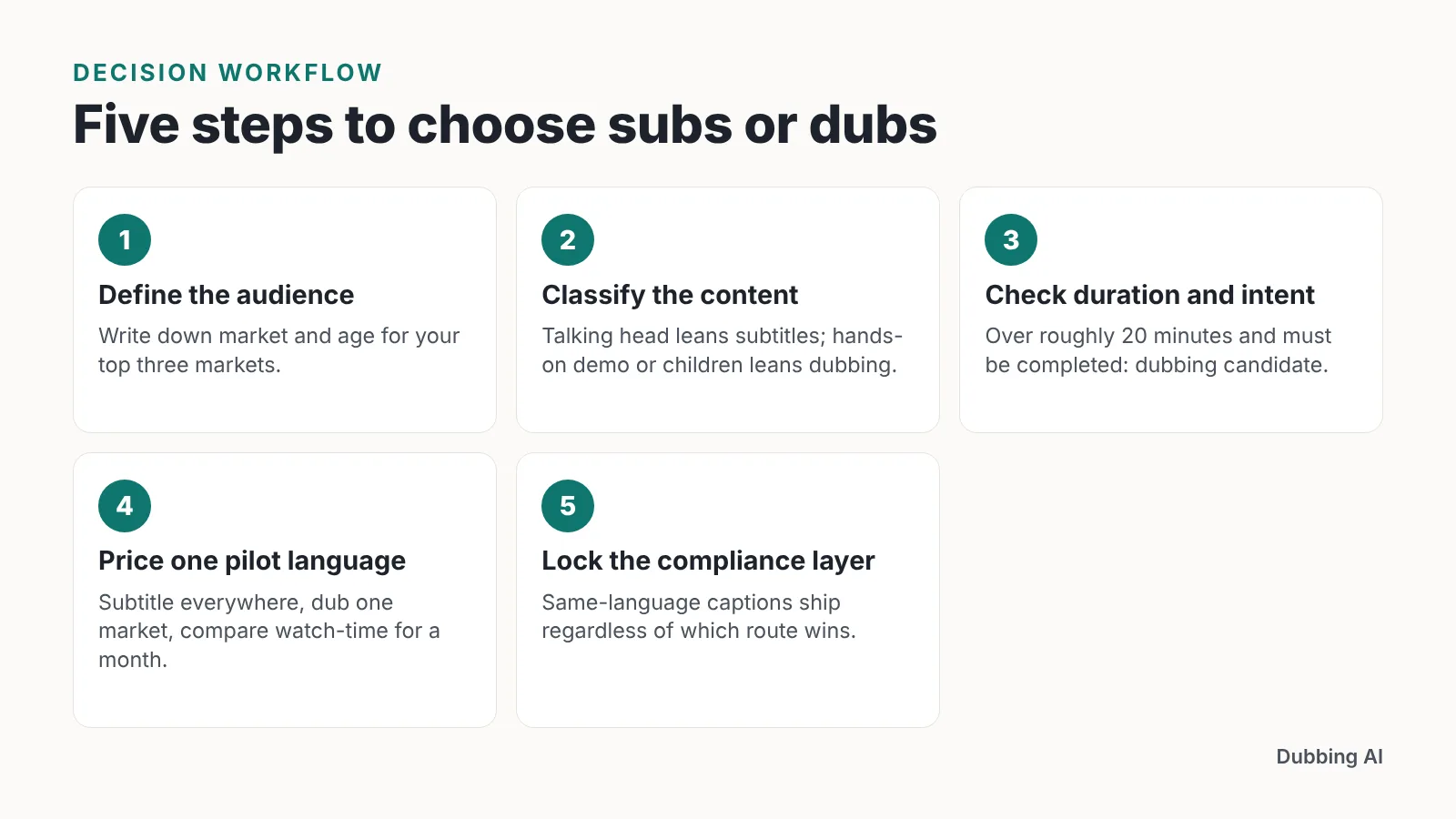
Five steps, run in this order:
- Define the audience by market and age. Markets conventionally treated as dubbing-first and under-30 audiences pull in opposite directions; write down which one your top three markets belong to.
- Classify the content. Talking head, panel or interview leans subtitles. Hands-on demo, visual tutorial or anything for children leans dubbing.
- Check duration and intent. Anything over roughly 20 minutes that people must complete, not just watch, is a dubbing candidate.
- Price both routes for one pilot language. Ship subtitles everywhere, dub one market, and compare watch-time and completion over a full month.
- Lock the compliance layer. Same-language captions ship regardless of which route wins, in every language where you publish.
Most teams land on a hybrid, and that is the correct answer more often than either extreme. Subtitle the full library, dub the top three courses or the five highest-traffic product videos, and let the retention data decide what gets dubbed next quarter.
Revisit the split every two quarters. Audience mix shifts, synthetic voice quality moves fast, and a market that did not justify a dub last year may justify one now.
Frequently asked questions
Is subbing or dubbing better for a global YouTube channel?
Start with subtitles on every video, then dub selectively. Preply found Americans prefer subtitles over dubbing by 80% to 20% for foreign-language content, and subtitle files also give YouTube indexable text that multi-language audio tracks do not provide on their own.
Do subtitles actually improve retention, or do they distract viewers?
Context decides it. Preply’s subtitle survey found 57% of surveyed Americans watch content in public and 74% of Gen Z do, so for muted viewing subtitles are the only comprehension path — but on dense visual tutorials, reading competes with watching the demonstration.
What is the difference between subtitles and closed captions?
Subtitles carry translated dialogue for viewers who do not speak the source language. Closed captions carry same-language dialogue plus speaker identification and non-speech sound cues for Deaf and hard-of-hearing viewers. Shipping a dub never removes a captioning obligation.
Is AI dubbing good enough to replace studio recording?
For training modules, internal communications and mid-budget marketing libraries, synthetic voices are frequently acceptable, and they make multi-language releases affordable at volume. Flagship brand films, children’s content and close-up dialogue that needs full emotional range still usually need human casting and a studio sync pass.
Which markets expect dubbing rather than subtitles?
Germany, France, Italy, Spain and much of Latin America are conventionally treated as dubbing-first markets, with long-established dubbing industries and audiences accustomed to dubbed theatrical and television releases — industry convention rather than a survey finding. Kapwing reports only 12% of people who localize content use dubbing, so treat it as a targeted investment, not a default.
Sources
This article was drafted with AI assistance and published by the Dubbing AI Editorial Team after its facts were checked against the sources listed above.