Studios split markets by tier: every shipping language gets translated UI and subtitles, while only the top revenue markets get full dubs. Work runs through one export, a locked glossary, post-edited MT, then recording or synthesis, LQA and platform tagging.
What video game translation services actually cover: UI strings, subtitles, voice-over, and store assets
Four separate production lines usually hide behind one localization quote. They have different file formats, different reviewers and different deadlines, and treating them as a single line item is how schedules slip in the final month before cert.
HTF Market Intelligence values the global game localization services market at USD 1820.4 million for 2024. Treat that as context for the quotes in front of you, not as a benchmark for your own budget.
| Workstream | What it contains | Who signs off |
|---|---|---|
| UI and system strings | Menus, tooltips, controller prompts, error messages, save states | UI designer plus a native linguist |
| Subtitles and captions | Timed dialogue text, barks, accessibility captions for sound events | Narrative lead and accessibility reviewer |
| Voice-over | Recorded or synthesized lines, lip-sync passes, pickup sessions | Voice director and audio lead |
| Store and marketing assets | Store page copy, trailer subtitles, achievement names, rating descriptors | Marketing plus platform submission owner |
Ask any vendor to price those four rows separately. A studio that only needs UI and subtitles for seven languages, with audio in two, should never receive a flat per-word number that blurs recording hours into text volume. Separate rows also let you cut audio for a weak market late without renegotiating the text contract.
The scenario: a 25-hour indie RPG shipping in 9 text languages with 3 full dubs
*Illustrative scenario, not data from a real title.*
Picture a 12-person studio with a 25-hour fantasy RPG, branching companion dialogue and a planned simultaneous launch on Steam and PlayStation. The string export comes back with a large volume of voiced lines and a long tail of combat barks that repeat across encounters.
Text goes out in nine languages: French, Italian, German, Latin American Spanish, Brazilian Portuguese, Japanese, Korean, Simplified Chinese and Russian. Full audio goes to three only — Simplified Chinese, Latin American Spanish and Brazilian Portuguese — because those wishlist regions showed the steepest drop-off in demo retention when players had to read subtitles during combat.
A player audit of Baldur’s Gate 3 calculated that the RPG ships with 236 hours of recorded dialogue, according to GamesRadar+, which is the scale a single full dub language can reach on a large narrative title. Your 25-hour RPG is far smaller, and that gap is exactly why an indie team can consider three dubs at all.
The constraint is not translation speed. It is studio booking, direction time across three languages, and the reintegration work that follows every script change your narrative designer makes after voice lock.
How studios decide which markets get subtitles and which get full audio
The decision is a ranked filter, not a gut call. Run every candidate language through the same five signals and write down the answer, because publishing partners will ask you to justify the audio budget.
| Signal | Points toward subtitles only | Points toward full audio |
|---|---|---|
| Wishlist and demo share | Long tail region | Top three regions |
| Local expectation | Subtitled imports are normal | Dubbing is the default for AAA releases |
| Voiced density | Dialogue is menu-based and pausable | Critical lines play during combat or driving |
| Reading load | Short exchanges | Dense, fast-cut conversation |
| Ongoing support | One-shot release | Live service with regular story drops |
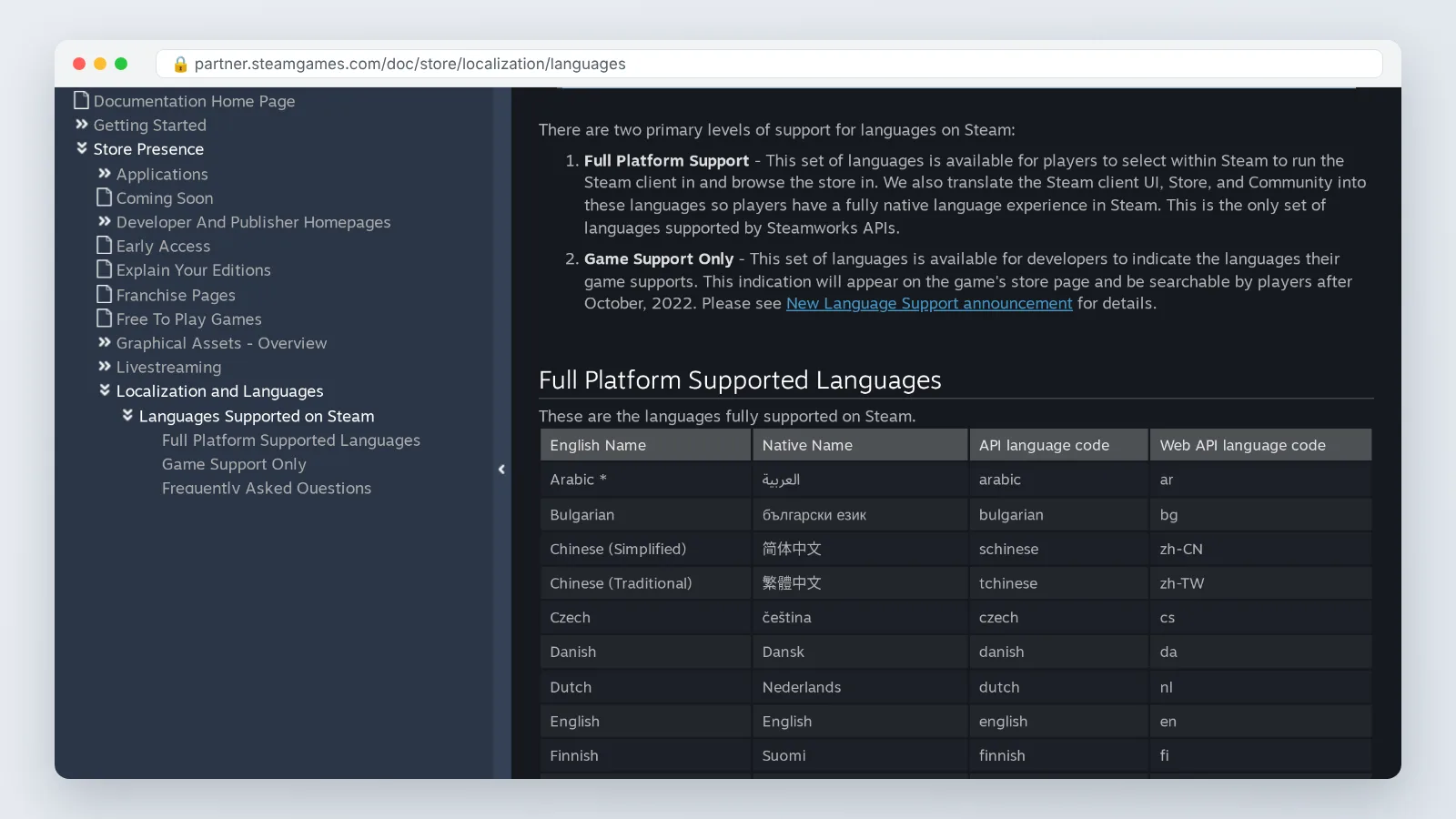
Steam provides full official platform support for 29 languages across its client, store and community features, according to Steamworks documentation, so a language outside that set carries extra friction before a single line is recorded.
Steamworks also documents two primary tiers of language support, where Full Platform Support languages are the ones players can actually run the Steam client and browse the store in. Players in a market that cannot browse the store in their own language rarely justify three weeks of booth time.
Before and after: the record-and-ship dubbing pipeline vs an AI-assisted hybrid
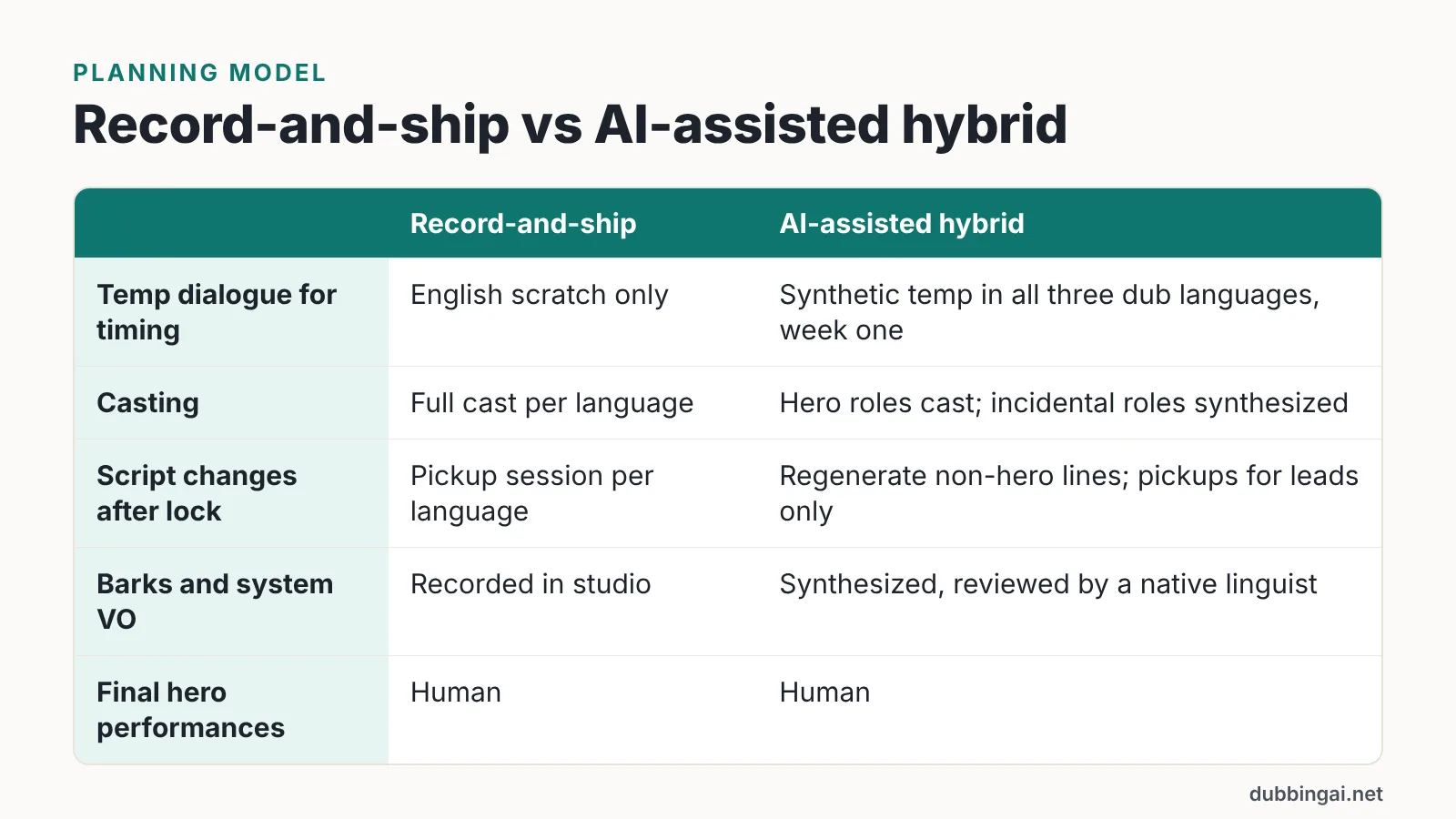
The traditional pipeline records everything once, late, and pays again for every script change. The hybrid pipeline uses synthetic voice early and in bulk, then spends the recording budget on the lines players remember.
The comparison below is a planning model, not measured benchmarks — build your own from your last title’s actuals.
| Stage | Record-and-ship | AI-assisted hybrid |
|---|---|---|
| Temp dialogue for timing | English scratch only | Synthetic temp in all three dub languages, week one |
| Casting | Full cast per language | Hero roles cast; incidental roles synthesized |
| Script changes after lock | Pickup session per language | Regenerate non-hero lines; book pickups for leads only |
| Barks and system VO | Recorded in studio | Synthesized, reviewed by a native linguist |
| Final hero performances | Human | Human |
The measurable difference shows up before launch, not after. Timing bugs that normally surface in the last LQA pass appear in week one, when a designer can still shorten a line instead of asking an actor to rush it.
The risk is honesty about quality. Synthetic delivery holds up for systemic VO and placeholders; it struggles with grief, sarcasm and anything the camera lingers on.
An 8-step procedure for localizing a build’s voice lines
Run these eight steps in order on every build. Skipping step two is the single most common cause of inconsistent faction names across a nine-language ship.
- Export. Pull all voiced lines with their IDs, speaker, scene context, emotion tag and maximum duration into one spreadsheet or loc platform.
- Glossary and style guide. Lock proper nouns, item names, honorifics and formality level per language before translation starts, and have a native reviewer approve it.
- Machine translation plus human post-edit. Pre-translate, then have in-market linguists edit for register and length, flagging lines that exceed the duration budget.
- Voice-over brief. Write per-character notes: age, accent, pacing, forbidden word choices, and which lines are performance-critical.
- Synthesis or recording. Generate synthetic passes for barks, system lines and temp tracks; book human sessions for leads. Platforms built for this work, such as AI Studios, offer text-to-speech voiceovers in 150+ languages and accents on paid plans and voice cloning from a short recording, which suits placeholder passes, store trailers and marketing cuts.
- Reintegration. Import audio against line IDs, verify file naming, and run an automated check for missing or zero-length assets.
- Linguistic QA in build. Native testers play the actual game, not a spreadsheet, and log truncation, wrong-speaker audio and tonal misses.
- Platform tagging. Declare support per language in each store back end and verify it renders on the live store page.
Consent, disclosure and performer pay when AI voices enter the pipeline
If you record in the United States with union talent, check the governing document. In July 2025 SAG-AFTRA members ratified a new Interactive Media Agreement that imposes consent and disclosure requirements on the use of AI digital replicas of performers, according to SAG-AFTRA.
Video game performers under the 2025 Interactive Media Agreement (ratified July 2025) received an immediate 15.17% compensation increase, according to SAG-AFTRA, with further 3% increases still ahead in November 2026 and November 2027. Budget your 2027 pickup sessions with those scheduled increases in mind.
Under the 2025 Interactive Media Agreement, AI consent and compensation obligations are triggered by recognizability — whether the generated output is objectively identifiable as a specific principal performer, according to law firm Davis+Gilbert LLP. That standard matters for cloned voices: a synthetic line that no listener could tie to a named performer sits differently from one that clearly does.
Practical steps for a signatory production: get written consent naming the specific use, log which lines are synthetic in your asset database, and tell your vendor in writing that no performer recording may train a model without a separate agreement. Studios outside the US, and non-signatory productions, are not bound by this agreement, though national labor law, contract terms and data protection rules still apply. This is general information, not legal advice — have counsel review your talent agreements.
QA and submission checks: character limits, lip-sync windows, Steam tags, and ratings
Localization bugs are found by playing, not by reading. Give each native tester a build, a controller and a route through every branch where translated audio plays.
Steamworks lets developers declare, per language, whether their game ships Subtitles, Interface or Full Audio, according to Steam’s documentation — that is the exact distinction between a subtitled market and a dubbed one, and mis-tagging it generates refund requests.
Check these before submission:
- Character limits. German and Russian strings commonly overflow buttons sized for English; test at the smallest supported resolution.
- Lip-sync windows. Verify each dubbed line fits the animation window, and flag anything the actor had to rush.
- Audio asset parity. Every line ID present in English exists in each dub language, with no zero-byte files.
- Store tags. Interface, Subtitles and Full Audio declared accurately per language on every storefront.
- Ratings. Confirm your translated descriptors match what ESRB, PEGI, USK and CERO expect for your content, since wording differs by board.
- Fallback behavior. A missing localized asset should fall back to English audio, not silence.
Budgeting and vendor selection: what to ask before you sign
Newzoo’s final figures put global video game market revenue at $182.7 billion in 2024, up 3.2% on 2023, according to Game World Observer — which is why vendors will happily quote you for every language you name. Your job is to buy only the ones that pay back.
Ask these questions on the first call:
- Who are the actual linguists, and will the same people work on the DLC in eight months?
- Do you price text and audio separately, and what is the rate for pickup sessions after voice lock?
- How do you handle in-context review — do your testers play the build or read a sheet?
- What is your written policy on machine translation and synthetic voice, and will you disclose where each was used?
- Who owns the translation memory and glossary when the contract ends?
- For union recordings, are you a signatory, and how do you document performer consent for any AI use?
Put the glossary ownership answer in the contract. A studio that loses its translation memory between a base game and its expansion pays twice for the same faction names, and players notice the inconsistency immediately.
Frequently asked questions
How many languages should a small studio localize at launch?
Start with text in the markets your wishlist data already favors, and reserve full audio for two or three. Steamworks documentation notes Steam provides full official platform support for 29 languages, so anything outside that set adds store friction before recording even begins.
Is AI voice acceptable for shipped game dialogue?
It holds up for barks, system prompts, placeholder timing passes and marketing cuts. For hero performances players quote back to you, cast humans. Disclose which lines are synthetic in your asset database so QA and legal review can trace every file.
What does the 2025 SAG-AFTRA agreement require for AI voices?
SAG-AFTRA reports that members ratified a new Interactive Media Agreement in July 2025 imposing consent and disclosure requirements on AI digital replicas of performers. Davis+Gilbert LLP notes obligations are triggered by recognizability as a specific principal performer. This is general information, not legal advice.
How much dialogue does a full dub language actually cover?
It depends entirely on scope. A player audit of Baldur’s Gate 3 calculated 236 hours of recorded dialogue, according to GamesRadar+, while a 25-hour indie RPG might run a far smaller line count per language, including repeated combat barks.
What is the difference between Subtitles, Interface and Full Audio on Steam?
Steamworks lets developers declare each of those three support types per language, according to Steam’s documentation. Interface covers menus and UI, Subtitles covers timed dialogue text, and Full Audio means recorded or synthesized voice in that language.
Sources
- Member Message: SAG-AFTRA Members Approve 2025 Interactive Media Agreement
- Artificial Intelligence — SAG-AFTRA
- SAG-AFTRA’s New Video Game Agreement — Davis+Gilbert LLP
- Localization and Languages (Steamworks Documentation)
- Languages Supported on Steam (Steamworks Documentation)
- Newzoo: In 2024, the global video game market generated $182.7 billion — Game World Observer
- Baldur’s Gate 3 player does the math, finds Larian’s RPG has 236 hours of recorded dialogue — GamesRadar+
- Game Localization Services Market Dynamics, Size, and Growth Trend 2025-2031 — HTF Market Intelligence
This article was drafted with AI assistance and published by the Dubbing AI Editorial Team after its facts were checked against the sources listed above.